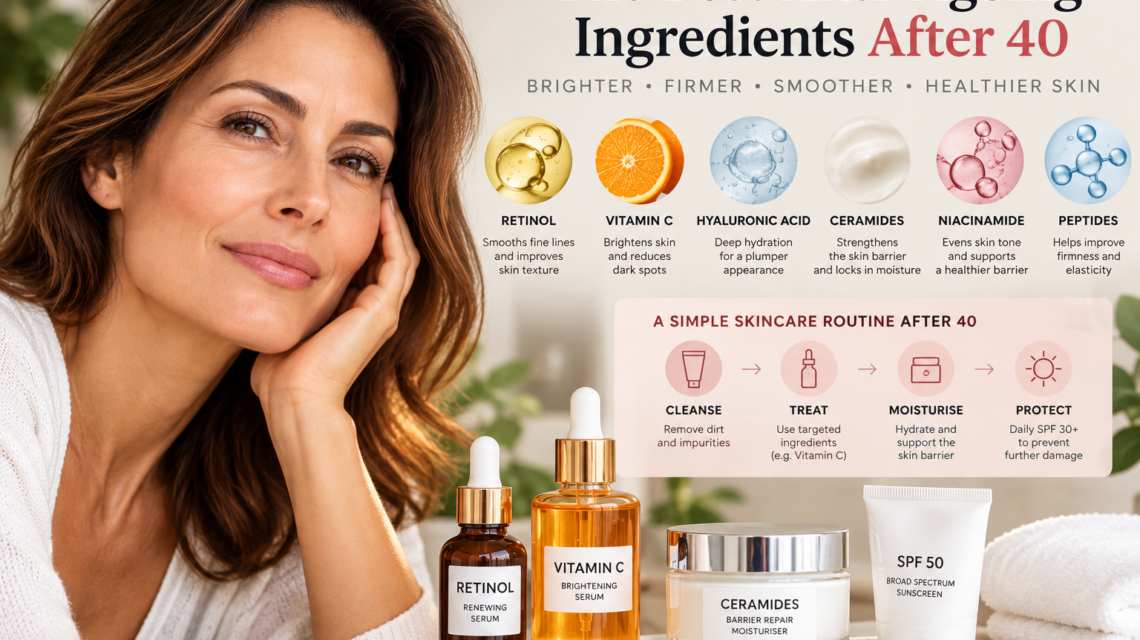
Turning 40 doesn’t mean your skin suddenly needs an entirely new routine. But it can be a good time to pay closer attention to what your skin needs. Fine lines may become more noticeable, dark spots can take longer to fade, and skin that once felt comfortably hydrated may start feeling dry or less supple.
The solution isn’t necessarily a shelf full of expensive anti-ageing products. It’s about understanding which skincare ingredients have useful evidence behind them, what they can realistically do, and how to incorporate them without irritating your skin.
From retinol and vitamin C to ceramides and peptides, these are the skincare ingredients worth knowing after 40—and how to choose the right ones for your skin.
What Changes in Your Skin After 40?
Skin changes at different rates depending on genetics, sun exposure, hormones, lifestyle and skin type. However, several changes may become more noticeable during your 40s and beyond:
- Reduced firmness: Collagen and elastin gradually decline, contributing to fine lines and changes in skin elasticity.
- Increased dryness: Skin may produce less oil and lose moisture more easily, making dehydration and roughness more noticeable.
- Uneven skin tone: Years of sun exposure can contribute to dark spots, pigmentation and a less even complexion.
- Slower-looking recovery: Skin may take longer to look refreshed after irritation or environmental stress.
- Greater sensitivity: Some people find that products they previously tolerated begin causing dryness, redness or stinging.
These changes are not identical for everyone. The aim of skincare after 40 should be to protect the skin barrier, address your main concerns and maintain healthy-looking skin—not to eliminate every line or change associated with ageing.
1. Retinol: For Fine Lines, Texture and Uneven Tone
Best for: Fine lines, uneven texture, mild pigmentation and some forms of acne.
Retinol is a vitamin A derivative belonging to a larger family of ingredients called retinoids. It is among the better-studied topical ingredients for improving the appearance of photoaged skin.
Retinol encourages skin-cell turnover and supports processes involved in collagen maintenance. With consistent use, it may help soften the appearance of fine lines, improve skin texture and reduce the visibility of some dark spots. Results are gradual, and retinol cannot completely reverse deeper wrinkles or restore all age-related volume loss. Cleveland Clinic
How to use retinol after 40
Start with a low-strength, over-the-counter retinol product and apply it at night two times a week. If your skin tolerates it, gradually increase the frequency.
Use a small amount on dry skin, avoid the immediate eye area and corners of the nose and mouth, and follow with a moisturiser. If dryness is a concern, applying moisturiser before retinol may improve comfort.
Retinol can cause dryness, peeling, redness and irritation, particularly when introduced too quickly. Avoid starting several strong active ingredients at the same time, and use broad-spectrum sunscreen every morning.
Worth knowing: Stronger is not automatically better. The most useful product is one you can tolerate and use consistently. Avoid topical retinoids during pregnancy or when trying to conceive unless your healthcare professional advises otherwise.
2. Vitamin C: For Brightness and Sun-Related Discolouration
Best for: Dull-looking skin, uneven tone and some forms of sun-related pigmentation.
Vitamin C is an antioxidant that helps protect skin from oxidative stress caused by environmental factors. Certain topical formulations can also support collagen production and help improve the appearance of dark spots and uneven skin tone.
L-ascorbic acid is a well-studied form of vitamin C, although it can be irritating for sensitive skin. Other derivatives are available, but their effectiveness depends on the formulation and supporting evidence.
How to use vitamin C after 40
Apply a vitamin C serum in the morning after cleansing, followed by moisturiser and sunscreen. If your skin is sensitive, start with a lower-strength formula or use it on alternate mornings.
Choose packaging that protects the formula from light and air where possible. If a product changes significantly in colour or develops an unusual smell, check the manufacturer’s guidance before continuing to use it.
Vitamin C is not a substitute for sunscreen. It works best as part of a routine that includes daily sun protection.
3. Broad-Spectrum Sunscreen: The Essential Daily Ingredient
Best for: Preventing sun damage, helping limit new dark spots and protecting skin from premature ageing.
If you choose only one anti-ageing skincare habit to prioritise, make it sunscreen.
Ultraviolet (UV) radiation contributes to wrinkles, pigmentation and other visible signs of skin ageing. Regular sunscreen use helps protect against further damage and is also important for reducing the risk of skin cancer.
Dermatologists generally recommend a broad-spectrum sunscreen with SPF 30 or higher. Water resistance is useful when swimming or sweating. American Academy of Dermatology
How to choose and use sunscreen
- Choose broad-spectrum SPF 30 or higher for everyday use.
- Apply it generously to exposed skin, including the face, neck, ears and hands.
- Reapply approximately every two hours when outdoors, and after swimming or heavy sweating, following the product label.
- Use protective clothing, shade and hats when possible.
If pigmentation is your main concern, a tinted sunscreen containing iron oxides may provide additional protection against visible light, which can worsen certain types of pigmentation, particularly in darker skin tones.
Worth knowing: Sunscreen is not just a summer product. In places with substantial year-round sun exposure, such as much of India, consistent protection is especially useful.
4. Ceramides: For a Stronger Skin Barrier
Best for: Dryness, tightness, flaking and skin that becomes easily irritated.
Ceramides are lipids naturally found in the outer layer of the skin. They help hold skin cells together and support the barrier that keeps moisture in while limiting the entry of irritants.
As skin becomes drier or its barrier is disrupted, a ceramide-containing moisturiser can help improve hydration and comfort. It may be particularly helpful if retinol or exfoliating products leave your skin feeling tight.
How to use ceramides after 40
Look for a moisturiser containing ceramides, especially if you have dry or sensitive skin. Ingredients such as glycerin, petrolatum and hyaluronic acid can complement ceramides by helping attract or retain moisture and reduce water loss.
Apply moisturiser after cleansing, while your skin is still slightly damp. If you use retinol, a well-formulated moisturiser can help make your routine more comfortable.
Ceramides do not directly erase wrinkles, but a healthy, hydrated skin barrier can make fine lines appear less prominent and help you tolerate other skincare ingredients.
5. Hyaluronic Acid: For Hydration and a Plumper Appearance
Best for: Dehydration, temporary plumping and fine lines that appear more visible when skin is dry.
Hyaluronic acid is a humectant, meaning it attracts and helps retain water. It is widely used in serums and moisturisers to improve skin hydration.
Well-hydrated skin often looks smoother and feels more comfortable. Fine lines caused or emphasised by dryness may also appear less noticeable, although hyaluronic acid does not permanently remove wrinkles or replace lost collagen.
How to use hyaluronic acid after 40
Apply a hyaluronic acid serum to slightly damp skin and follow it with a moisturiser to help reduce moisture loss. You do not necessarily need a separate serum if your existing moisturiser already provides enough hydration.
Hyaluronic acid is generally suitable for many skin types, including oily skin that is also dehydrated.
Worth knowing: A higher percentage does not automatically mean a better product. The overall formulation and how comfortably it works with your skin matter more than a headline concentration.
6. Niacinamide: A Versatile Ingredient for Uneven Tone and Barrier Support
Best for: Uneven-looking skin, redness, excess oil, visible pores and moisture-barrier support.
Niacinamide is a form of vitamin B3 used in a wide range of skincare products. It can support the skin barrier, help reduce moisture loss and improve the appearance of uneven tone. It may also help some people manage excess oil and redness.
This makes it a useful option if your skin needs more than hydration but does not tolerate strong exfoliants or retinoids well. Cleveland Clinic
How to use niacinamide after 40
Niacinamide can be used in the morning or evening, depending on the product instructions. It is often available in moisturisers and serums, so a separate product may not be necessary.
Start with a modest concentration, particularly if you have sensitive skin. Very high concentrations are not automatically more effective and can cause irritation in some people.
Niacinamide can complement ingredients such as ceramides, hyaluronic acid and retinol. Introduce products gradually so you can identify what works for your skin.
7. Alpha-Hydroxy Acids: For Rough Texture and Dullness
Best for: Roughness, uneven texture and a dull-looking complexion.
Alpha-hydroxy acids (AHAs), including glycolic acid and lactic acid, are chemical exfoliants that help loosen the bonds between dead skin cells at the surface. They can improve the appearance of skin texture and, with suitable formulations, help reduce some superficial discolouration.
Lactic acid may be a useful option for people who want exfoliation alongside some humectant benefits. Glycolic acid can penetrate the skin effectively but may be irritating, depending on its concentration and formulation.
How to use AHAs after 40
Begin with a low-strength product once a week, then increase only if your skin tolerates it. Follow the product instructions and moisturise afterwards.
Avoid aggressive scrubs and excessive exfoliation, especially if your skin is already dry or sensitive. Using an AHA alongside retinol too frequently can increase irritation, so consider alternating nights rather than layering both at the beginning.
Exfoliating acids can increase sensitivity to sunlight. Daily sunscreen is essential.
8. Peptides: A Potential Addition for Firmness-Focused Routines
Best for: People interested in supporting the appearance of smoother, firmer skin.
Peptides are short chains of amino acids used in some skincare formulations. Certain peptides are marketed to support skin conditioning or signalling processes associated with the skin’s structure.
However, peptides are not one single ingredient, and the evidence varies considerably between different types and formulations. Some products may improve the appearance of skin, but topical peptides should not be assumed to produce the same results as prescription retinoids or established sun-protection measures.
Are peptides worth buying after 40?
They may be worth considering if you want an additional serum or moisturiser and your basic routine is already working well. Choose products with transparent ingredient information and realistic claims.
If your budget is limited, prioritise sunscreen, moisturiser and a suitable retinoid before investing heavily in multiple peptide products. These are generally more practical foundations for a routine aimed at visible signs of skin ageing.
9. Azelaic Acid: For Persistent Redness and Pigmentation
Best for: Uneven skin tone, post-acne marks and some forms of redness or acne.
Azelaic acid has anti-inflammatory properties and can help address acne and certain pigmentation concerns. It is also used in the management of rosacea, although persistent redness or suspected rosacea is best assessed by a healthcare professional.
For people whose main concern is pigmentation rather than fine lines, azelaic acid may be more relevant than adding another anti-wrinkle serum.
How to use azelaic acid after 40
Start according to the product’s directions and introduce it separately from other strong actives. Some formulations are available over the counter, while stronger preparations may require medical guidance.
If dark patches are new, changing or persistent, seek a dermatologist’s advice rather than assuming they are ordinary age spots. Sunscreen remains important for preventing pigmentation from worsening.
10. Glycerin and Other Moisturisers: The Unsung Essentials
Best for: Dryness, roughness, dehydration and maintaining skin comfort.
Not every useful skincare ingredient needs to be marketed as an anti-ageing breakthrough. Glycerin is a well-established humectant that attracts water to the outer layers of the skin. Petrolatum and dimethicone can help reduce moisture loss and improve the skin’s feel.
A good moisturiser may do more for the appearance of dry, lined skin than an expensive serum that irritates it.
What to look for
Choose a moisturiser suited to your skin type. Drier skin may benefit from a richer cream containing ceramides and occlusive ingredients, while oily skin may prefer a lighter lotion or gel-cream.
The goal is not to make skin greasy. It is to keep it comfortable, hydrated and resilient enough to tolerate the ingredients you use for specific concerns.
Which Skincare Ingredients Should You Prioritise After 40?
You do not need every ingredient listed above. Start with your biggest concern and build a routine around it.
| Your main concern | Ingredients to consider |
|---|---|
| Fine lines and uneven texture | Retinol, moisturiser, sunscreen |
| Dark spots and uneven tone | Sunscreen, vitamin C, niacinamide or azelaic acid |
| Dryness and tightness | Ceramides, glycerin, hyaluronic acid |
| Rough or dull-looking skin | A gentle AHA, moisturiser, sunscreen |
| Redness or easily irritated skin | Ceramides, niacinamide; consider professional advice if persistent |
| Loss of firmness | Sunscreen and a retinoid; peptides are an optional addition |
The best choice depends on your skin type, medical history, tolerance and the specific formulation—not simply your age.
A Simple Morning and Evening Skincare Routine After 40
A routine does not have to involve ten steps to be effective. Start with the basics, then add one targeted ingredient at a time.
Morning routine
- Gentle cleanser: Remove overnight oil and residue without stripping the skin.
- Optional targeted serum: Use vitamin C for antioxidant support or niacinamide for barrier support and uneven tone.
- Moisturiser: Apply if your skin needs additional hydration.
- Broad-spectrum sunscreen: Finish with SPF 30 or higher.
Evening routine
- Gentle cleanser: Remove sunscreen, makeup, sweat and dirt.
- Targeted treatment: Use retinol on selected nights if appropriate for your skin.
- Moisturiser: Support hydration and help maintain the skin barrier.
On nights when you are not using retinol, focus on moisturising. If you want to introduce an exfoliating acid, use it on a separate night initially rather than adding several active ingredients together.
Give a new routine time to work. Hydration can improve the appearance of skin relatively quickly, but changes in fine lines, texture and pigmentation may take several weeks or months. Stop a product if it causes significant burning, swelling or persistent irritation.
Common Skincare Mistakes to Avoid After 40
Even well-chosen ingredients can disappoint if the routine is too aggressive.
- Starting everything at once: Introduce one new active ingredient at a time so you can identify irritation or sensitivity.
- Skipping sunscreen: Expensive serums cannot compensate for repeated, unprotected UV exposure.
- Over-exfoliating: Excessive acids, scrubs and retinoids can damage the skin barrier and make redness and dryness worse.
- Chasing high percentages: Concentration alone does not determine effectiveness; formulation and tolerance matter.
- Ignoring the neck and hands: These areas are also exposed to sunlight and can benefit from moisturiser and sun protection.
- Expecting instant results: Most ingredients that target fine lines and pigmentation require consistent use.
- Assuming every dark spot is harmless: New, changing or unusual lesions should be evaluated by a qualified clinician.
Frequently Asked Questions
Is retinol necessary after 40?
No. Retinol is a useful option for people concerned about fine lines, texture or some forms of pigmentation, but it is not essential for everyone. Sunscreen and moisturiser are more fundamental. If your skin is sensitive, you may prefer to focus on barrier support or discuss alternatives with a dermatologist.
Can I use vitamin C and retinol together?
Many people can use both in the same overall routine. A simple approach is vitamin C in the morning and retinol at night. Introduce each separately, monitor your skin’s response and avoid combining too many irritating products at once.
Is hyaluronic acid better than retinol?
They serve different purposes. Hyaluronic acid primarily supports hydration, while retinol targets concerns such as fine lines and uneven texture. They can complement each other, and hyaluronic acid may help make a retinol routine more comfortable.
Should I use niacinamide every day?
Many people tolerate niacinamide daily, but the right frequency depends on the formulation and your skin’s response. If you experience irritation, reduce use or discontinue the product.
How long does skincare take to show results after 40?
Hydration and skin comfort may improve within days. Improvements in texture, fine lines and pigmentation often take several weeks to a few months, and results vary. Consistency matters more than frequently changing products.
Do I need an eye cream after 40?
Not necessarily. A regular moisturiser that is suitable for the eye area may be enough for dryness. A dedicated eye cream can be useful if it addresses a specific concern, but it is not a requirement for everyone.
Can skincare reverse ageing?
No topical skincare routine can stop biological ageing or completely reverse structural changes in the skin. However, sunscreen, moisturisers and selected active ingredients can help prevent further sun damage and improve the appearance of some visible signs of ageing.
The Bottom Line
The skincare ingredients worth knowing after 40 are the ones that address your actual concerns and fit comfortably into a routine you can maintain. Sunscreen helps protect against future sun damage, moisturisers support the skin barrier, retinol can improve the appearance of fine lines and texture, and ingredients such as vitamin C, niacinamide and azelaic acid may help with uneven tone.
Start simple. Protect your skin every morning, moisturise consistently and introduce targeted treatments gradually. You do not need the most expensive products or the longest routine—you need ingredients that make sense for your skin, realistic expectations and the patience to use them consistently.
This article is for general educational purposes and is not a substitute for personalised medical advice. Consult a dermatologist if you have persistent irritation, significant pigmentation, a changing skin lesion or a skin condition that needs treatment.