You don’t need to wait for an annual physical to start paying attention to your health. Today, a growing range of consumer gadgets can help you track your heart rate, monitor your sleep, measure your blood pressure, and understand how your daily habits affect your body.
But not every health metric is equally useful, and not every device is equally reliable. A smartwatch may estimate how well you slept, while a blood pressure monitor measures a specific health indicator that can help your doctor assess cardiovascular risk. A smart scale might reveal a weight trend, but its body-fat estimate is not the same as a clinical measurement.
The smartest approach is to choose devices that answer meaningful questions about your health—not simply collect more numbers.
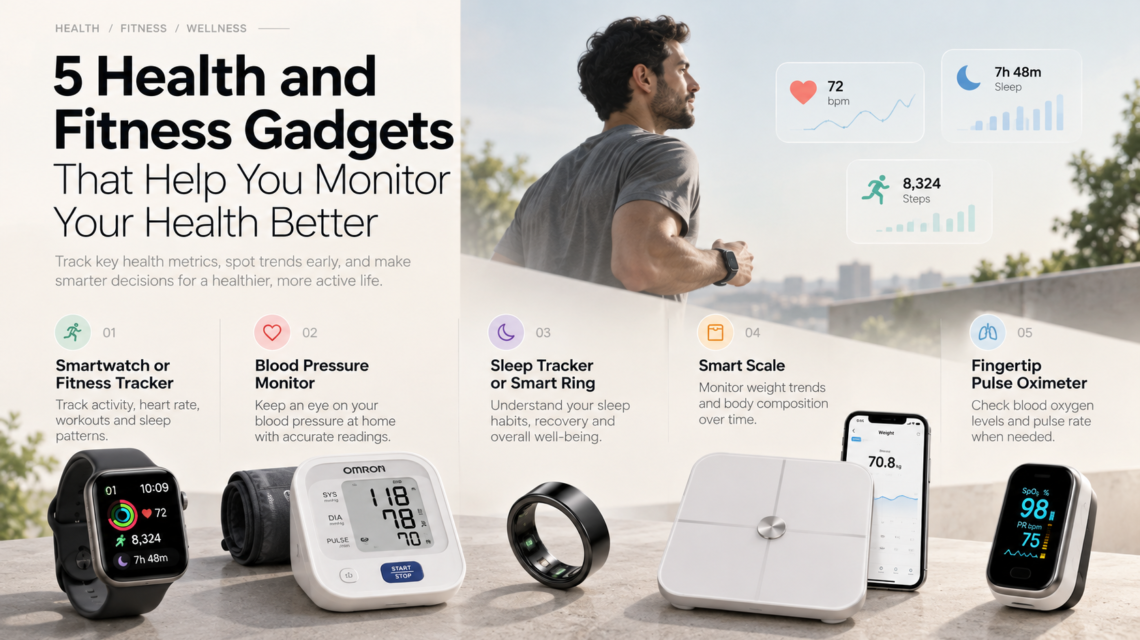
Here are five health and fitness gadgets worth considering, what each one can tell you, and what to keep in mind before buying.
1. Smartwatch or Fitness Tracker: Your Everyday Health Dashboard
A smartwatch or fitness tracker is often the easiest starting point for anyone who wants to become more aware of their daily activity.
Devices from brands such as Apple, Garmin, Fitbit, and Samsung can track various combinations of steps, exercise duration, heart rate, sleep estimates, and workout performance. Some models also offer features such as ECG recordings or notifications about potentially irregular heart rhythms, depending on the device and region.
The real value isn’t necessarily knowing your exact step count every minute. It’s recognizing patterns.
For example, you might discover that you move much less on work-from-home days, that your resting heart rate changes when you are unwell, or that you consistently sleep less than you thought.
What can it help you monitor?
- Daily activity: Steps, movement, and active minutes.
- Heart rate: Resting and exercise-related heart-rate trends.
- Workout performance: Duration, pace, distance, and estimated effort.
- Sleep patterns: Estimated sleep duration and, on some devices, sleep stages.
- Selected heart-health features: Certain models can record an ECG or flag possible irregular rhythms.
What should you watch out for?
Consumer wearables are useful for trends, but their measurements are not all equally accurate. Calorie-burn estimates, sleep-stage estimates, and some heart-rate readings can differ from more specialized measurements.
Do not assume that a normal smartwatch reading rules out a medical problem. Likewise, an unexpected alert should be interpreted in context rather than treated as a diagnosis.
Buying tip: Choose a device that is comfortable, has a battery life you can live with, and tracks the metrics you will actually use. If your primary goal is fitness, activity and heart-rate tracking may matter more than a long list of advanced features.
2. Automatic Upper-Arm Blood Pressure Monitor: A Practical Heart-Health Tool
High blood pressure often has no obvious symptoms. You can feel perfectly fine while your readings remain elevated, which is one reason measuring it properly matters.
An automatic upper-arm blood pressure monitor lets you check your blood pressure at home and record readings over time. This can help you and your healthcare professional understand whether your blood pressure is consistently high and whether treatment is working.
The American Heart Association recommends automatic, cuff-style upper-arm monitors and advises choosing a validated device with a cuff that fits correctly. Read the AHA’s home-monitoring guide.
What can it help you monitor?
- Systolic pressure: The pressure in your arteries when your heart beats.
- Diastolic pressure: The pressure between heartbeats.
- Changes over time: Whether readings tend to be higher or lower across repeated measurements.
- Response to treatment: Information your clinician can use when reviewing your blood pressure management.
What should you watch out for?
A single reading does not tell the whole story. Stress, recent exercise, caffeine, body position, and an incorrectly fitted cuff can affect measurements.
For a more reliable reading, sit quietly for about five minutes, keep your back supported and feet flat, and position your arm at heart level. Follow the device’s instructions and your clinician’s recommendations for how often to measure.
The FDA also warns consumers against unauthorized devices and wearable features that claim to measure or estimate blood pressure. Do not assume that a smartwatch or smart ring can replace a validated cuff-based monitor. <a href=”https://www.fda.gov/medical-devices/safety-communications/do-not-use-unauthorized-devices-measuring-blood-pressure-fda-safety-communication“>Read the FDA’s safety communication</a>.
Buying tip: Check the exact model against a recognized validation list, such as ValidateBP, and ensure the cuff size is appropriate for your arm.
3. Sleep Tracker or Smart Ring: Understand Your Sleep Habits
Sleep affects energy, mood, concentration, exercise performance, and overall well-being. Yet many people underestimate how little they sleep or how irregular their sleep schedules have become.
A dedicated sleep tracker, smart ring, or compatible smartwatch can help make these patterns more visible.
Depending on the device, it may estimate how long you slept, how often you woke up, your nighttime heart rate, and other signals associated with sleep and recovery.
What can it help you monitor?
- Sleep duration: How much time you appear to spend asleep.
- Sleep consistency: Whether your bedtime and wake time vary substantially.
- Nighttime trends: Changes in heart rate and other available measurements.
- Recovery estimates: Some devices combine sleep, activity, and heart-rate data into a daily readiness or recovery score.
What should you watch out for?
Sleep trackers estimate sleep using movement and physiological signals. They cannot reliably tell you everything about your sleep quality, and consumer sleep-stage estimates are not equivalent to a clinical sleep study.
A low sleep score on one night does not necessarily mean something is wrong. Look for persistent patterns rather than trying to achieve a perfect score every day.
If you regularly feel exhausted despite spending enough time in bed, snore loudly, or wake up gasping, talk with a healthcare professional. A wearable cannot rule out sleep apnea or another sleep disorder.
Buying tip: Comfort is crucial. If you dislike wearing a device overnight, a tracker that stays on your wrist or a non-wearable sleep monitor may suit you better than a ring.
4. Smart Scale: Track Weight Trends Beyond a Single Number
A smart scale connects to a smartphone app and records your measurements automatically. Depending on the model, it may also estimate body-fat percentage, lean mass, body water, and other body-composition metrics.
Its biggest advantage is convenience. Rather than recording your weight manually, you can view trends over weeks or months.
This can be useful if you are managing your weight, working toward a fitness goal, or simply trying to understand how your measurements change over time.
What can it help you monitor?
- Body weight: Changes across days, weeks, and months.
- Long-term trends: Whether your weight is generally rising, falling, or staying stable.
- Estimated body composition: Some models provide estimates of body fat and other measurements.
- Habit consistency: A record that can help you evaluate whether your routine is working for you.
What should you watch out for?
Body weight fluctuates naturally with hydration, food intake, digestion, and other factors. A small increase overnight does not automatically mean you gained body fat.
Body-composition readings from consumer scales are estimates and can be affected by hydration and the device’s measurement method. They should not be treated as definitive measurements of muscle or fat.
Also, weighing yourself frequently is not helpful for everyone. If it increases anxiety or encourages unhealthy eating behaviors, consider tracking less often or choosing other indicators of progress.
Buying tip: If your primary goal is weight management, a reliable scale with an easy-to-read weight history may be more useful than paying extra for numerous uncertain body-composition metrics.
5. Fingertip Pulse Oximeter: Check Blood Oxygen When Appropriate
A pulse oximeter is a small device that clips onto a fingertip and estimates the percentage of oxygen carried in your blood, known as oxygen saturation or SpO₂. It also typically displays your pulse rate.
Unlike a smartwatch that provides a broad collection of wellness metrics, a pulse oximeter focuses on a specific measurement that can be useful in certain medical situations.
A healthcare professional may recommend one for some people with respiratory or heart conditions, or when monitoring oxygen levels at home is part of a care plan.
What can it help you monitor?
- Estimated oxygen saturation: The proportion of oxygenated hemoglobin detected by the device.
- Pulse rate: Your measured pulse during the reading.
- Changes over time: Readings that may be useful when interpreted alongside symptoms and clinical advice.
What should you watch out for?
A pulse oximeter does not measure your overall fitness, and a normal reading does not guarantee that you are healthy.
Readings can be affected by movement, cold hands, circulation, nail polish, device quality, and skin pigmentation. The FDA advises people not to rely on pulse oximeter readings alone when making health decisions. <a href=”https://www.fda.gov/medical-devices/products-and-medical-procedures/pulse-oximeters“>Read the FDA’s pulse oximeter guidance</a>.
If you are feeling seriously unwell or experiencing significant breathing difficulty, seek medical attention rather than waiting for a device reading.
Buying tip: If you need to monitor oxygen levels for a medical reason, ask your healthcare professional which device is suitable and what readings or symptoms should prompt action.
Which Health Gadget Should You Buy First?
You do not need all five devices to take better care of yourself. The right starting point depends on what you want to learn.
| Your main goal | Consider starting with |
|---|---|
| Move more and track workouts | Smartwatch or fitness tracker |
| Monitor diagnosed high blood pressure | Validated upper-arm blood pressure monitor |
| Understand sleep habits | Sleep tracker or smart ring |
| Track weight over time | Digital or smart scale |
| Monitor blood oxygen when medically advised | Fingertip pulse oximeter |
If you have a specific medical condition, prioritize the monitoring device recommended by your healthcare professional rather than buying a general wellness gadget and hoping it will answer a clinical question.
How to Use Health Gadgets Without Becoming Obsessed With the Numbers
More data does not always mean better health. Constantly checking every metric can become stressful, especially when normal fluctuations are mistaken for signs of illness.
Use these simple rules to get more value from your devices:
- Choose a clear purpose. Decide what you want to monitor before purchasing a gadget.
- Focus on trends. Look at patterns over time rather than reacting to every isolated reading.
- Understand the limitations. An estimate from a consumer device is not always a clinical measurement.
- Record relevant symptoms. How you feel matters alongside the numbers.
- Share useful data with your clinician. A log of repeated blood pressure readings, for example, can be more informative than a single measurement.
- Avoid changing treatment based on a gadget alone. Do not stop medication or make major health decisions without appropriate medical guidance.
Health technology is most useful when it helps you make better decisions, not when it creates a new reason to worry.
The Bottom Line
The best health and fitness gadget is not necessarily the most expensive one or the device with the longest list of features. It is the one that helps you answer a useful question about your health and gives you information you can act on.
A fitness tracker can encourage more movement. A validated blood pressure monitor can help you keep track of an important cardiovascular measure. A sleep tracker can reveal inconsistent habits, while a smart scale can make long-term weight trends easier to follow. A pulse oximeter may be useful when oxygen monitoring is medically appropriate.
Start with one meaningful goal, learn what your chosen device can and cannot measure, and use the information to support healthier habits and better conversations with your healthcare professional.
Frequently Asked Questions
1. What is the most useful gadget for monitoring overall health?
For general wellness, a smartwatch or fitness tracker can provide useful information about activity, heart rate, and sleep patterns. People managing a particular condition may benefit more from a dedicated device, such as a validated blood pressure monitor.
2. Are smartwatches accurate enough to monitor heart health?
They can provide useful heart-rate trends, and certain models offer specific features such as ECG recordings or irregular-rhythm notifications. However, features vary by model, and consumer wearables cannot rule out every heart problem.
3. Can a smartwatch replace a blood pressure monitor?
No. The FDA warns against relying on unauthorized wearable features that claim to measure blood pressure. A validated upper-arm cuff is the recommended starting point for home blood pressure monitoring.
4. Are smart scales worth buying?
They can be useful for automatically recording weight trends. However, body-fat and muscle-mass estimates from consumer scales should be treated cautiously rather than as precise clinical measurements.
5. Do sleep trackers accurately measure deep sleep and REM sleep?
They estimate sleep stages using movement and physiological signals. These estimates can help reveal broad patterns, but they are not equivalent to a clinical sleep study.
6. Should everyone own a pulse oximeter?
Not necessarily. It can be useful for people who have been advised to monitor oxygen levels, but it is not essential for every healthy adult and should not be used as a substitute for medical evaluation.
Sources and Further Reading
- U.S. Food and Drug Administration — Blood Pressure Device Safety Communication
- American Heart Association — Home Blood Pressure Monitoring
- U.S. Food and Drug Administration — Pulse Oximeters
- U.S. Department of Health and Human Services — Remote Patient Monitoring
This article is for general educational purposes and is not a substitute for individualized medical advice.