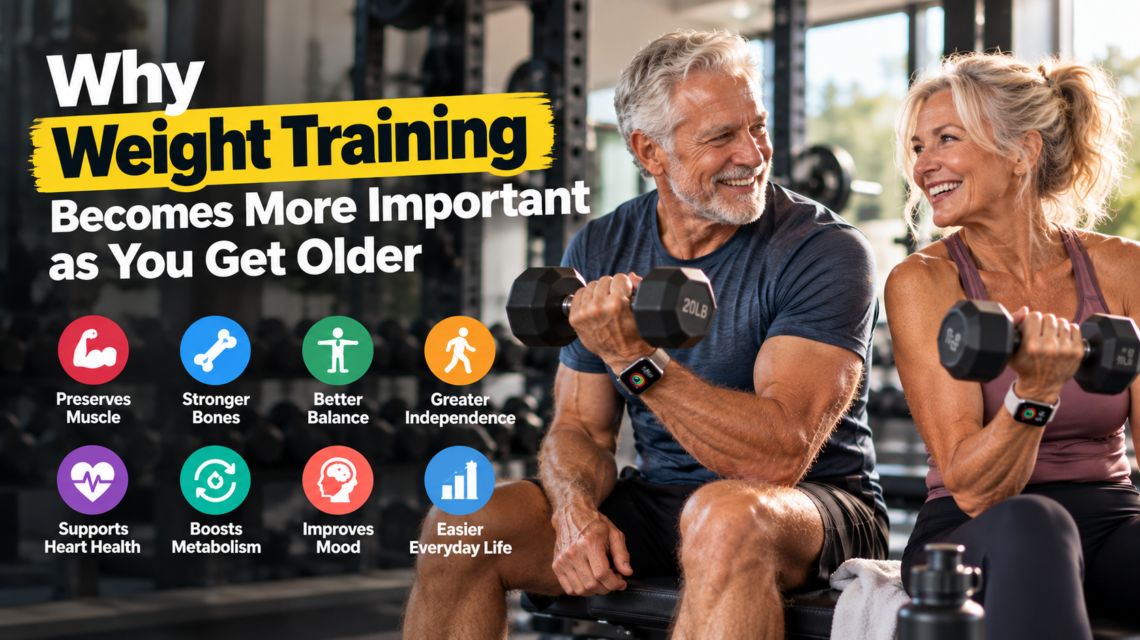
For years, exercise advice for older adults has often focused on walking, stretching and low-impact cardio. These activities can be excellent for overall health, but there is another form of exercise that becomes increasingly important with age: strength training.
Weight training is not just about building bigger muscles. For older adults, it can help preserve strength, support independence, improve balance, protect bones and make everyday activities easier.
The good news is that you do not need to lift extremely heavy weights or spend hours in a gym to benefit. A well-designed strength training routine can be adapted to almost any fitness level.
What Happens to Muscle as We Age?
Starting in midlife, people gradually lose muscle mass and strength. This process, known as sarcopenia, can accelerate with advancing age, especially when physical activity levels decline.
The consequences can extend far beyond appearance.
Less muscle strength can make everyday tasks more difficult, including:
- Getting up from a chair
- Climbing stairs
- Carrying groceries
- Getting out of a car
- Lifting household objects
- Maintaining balance
- Walking longer distances
This can create a cycle in which reduced activity leads to further loss of strength.
Strength training can help interrupt that cycle by giving muscles a reason to remain strong and functional.
1. It Helps Preserve Muscle and Strength
One of the most important reasons older adults should consider resistance training is simple: muscles respond to resistance throughout life.
Resistance can come from:
- Dumbbells
- Resistance bands
- Weight machines
- Kettlebells
- Bodyweight exercises
- Household objects
Regular training can stimulate muscle growth and help maintain strength, even when someone starts exercising later in life.
This is particularly important because maintaining strength is about much more than fitness. It can determine how easily a person can continue living independently.
2. Stronger Legs Can Help You Stay Independent
Lower-body strength becomes particularly valuable with age.
Exercises such as squats, chair stands, step-ups and leg presses can train the muscles needed for everyday movement.
Consider something as ordinary as standing up from a chair. It requires coordinated strength from the thighs, hips and core.
If those muscles become significantly weaker, a simple movement can eventually become challenging.
Maintaining lower-body strength can therefore help older adults continue performing everyday activities without relying heavily on another person.
3. Strength Training Can Support Better Balance
Falls are a major concern among older adults.
Strength training alone is not a complete fall-prevention program, but stronger muscles can contribute to better stability and movement. Exercises that train the legs, hips and core can make it easier to control the body while walking, changing direction or getting up from a seated position.
For older adults with balance concerns, strength exercises can be combined with activities specifically designed to improve balance and coordination.
4. It Can Help Protect Bone Health
Bones respond to mechanical stress.
Weight-bearing activity and resistance training can provide stimulus that supports bone strength. This becomes particularly relevant as bone density tends to decline with age.
Exercises such as squats, rows and controlled presses can provide resistance through the muscles and skeletal system.
People who have osteoporosis, a history of fractures or significant bone loss should speak with a healthcare professional or qualified exercise specialist before beginning a new strength program.
5. It Can Make Everyday Activities Easier
One of the best measures of fitness in older age isn’t necessarily how much weight someone can lift.
It is how easily they can live their life.
Strength training can improve the physical capacity required for activities such as:
Carrying: groceries, luggage and household items.
Pushing and pulling: doors, furniture and household equipment.
Climbing: stairs and curbs.
Getting up and down: chairs, beds and the floor.
Reaching: placing objects on shelves or lifting items overhead.
The goal isn’t necessarily to become a bodybuilder. It is to make everyday life feel less physically demanding.
6. It Can Support Metabolic Health
Muscle is metabolically active tissue and plays an important role in how the body handles glucose.
Regular resistance training can contribute to better metabolic health and insulin sensitivity, particularly when combined with aerobic activity and a balanced diet.
For older adults, maintaining muscle while managing body weight can be more useful than focusing exclusively on the number on the scale.
7. It May Improve Confidence and Quality of Life
Physical capability can influence confidence.
Being able to walk comfortably, carry your own shopping bags or get up from the floor without assistance can provide a sense of independence.
Exercise can also provide social benefits when people participate in group classes, walking groups or supervised strength programs.
For many older adults, the biggest benefit of training isn’t a change in appearance. It is feeling more capable.
8. You Don’t Need to Lift Extremely Heavy Weights
A common misconception is that strength training requires lifting very heavy weights.
It doesn’t.
Older beginners can start with relatively light resistance and focus on:
- Learning the movement
- Using controlled technique
- Performing an appropriate number of repetitions
- Gradually increasing resistance over time
For someone who has been inactive, even basic movements such as repeated chair stands or resistance-band exercises can provide a meaningful starting point.
The principle is progressive overload, meaning that the muscles are gradually challenged more as the person becomes stronger.
What Should an Older Person’s Strength Routine Include?
A simple full-body program can focus on the major movement patterns.
| Movement | Beginner options |
|---|---|
| Squat | Chair squat |
| Push | Wall push-up |
| Pull | Resistance-band row |
| Hinge | Light hip hinge |
| Step | Low step-up |
| Carry | Light dumbbell carry |
| Core | Supported core exercises |
A typical beginner might perform strength training two or more days per week, allowing adequate recovery between sessions.
The exact exercises, resistance and volume should be adjusted according to fitness level, medical conditions and previous exercise experience.
What About Cardio?
Strength training shouldn’t necessarily replace cardiovascular exercise.
For many older adults, the best approach is a combination of:
Strength training + aerobic activity + balance work + mobility
Walking, cycling, swimming or other cardiovascular activities can support heart and lung health, while resistance training addresses muscle and strength.
Balance and mobility exercises can complement both.
Together, these forms of exercise create a more complete fitness program.
Safety Matters
Older adults who have been inactive for a long time should start gradually.
Extra caution may be appropriate for people with:
- Heart or cardiovascular conditions
- Significant joint problems
- Osteoporosis or previous fractures
- Uncontrolled blood pressure
- Neurological conditions
- Recent surgery
- Significant dizziness or balance problems
A healthcare professional or qualified exercise professional can help determine which exercises are appropriate.
During training, proper technique is more important than lifting heavier weights. Sharp pain, unusual chest discomfort, severe shortness of breath or dizziness should not be ignored.
The Bottom Line
Getting older doesn’t mean strength training becomes less important. In many ways, it becomes more important.
Maintaining muscle and strength can help older adults remain active, independent and capable of handling everyday physical demands. Resistance training can also complement cardiovascular exercise, balance work and mobility training to create a more complete approach to healthy aging.
You don’t have to lift enormous weights.
You don’t have to spend hours in the gym.
You simply need to give your muscles a regular reason to stay strong.
For healthy aging, strength isn’t just about fitness. It’s about maintaining the ability to live independently.