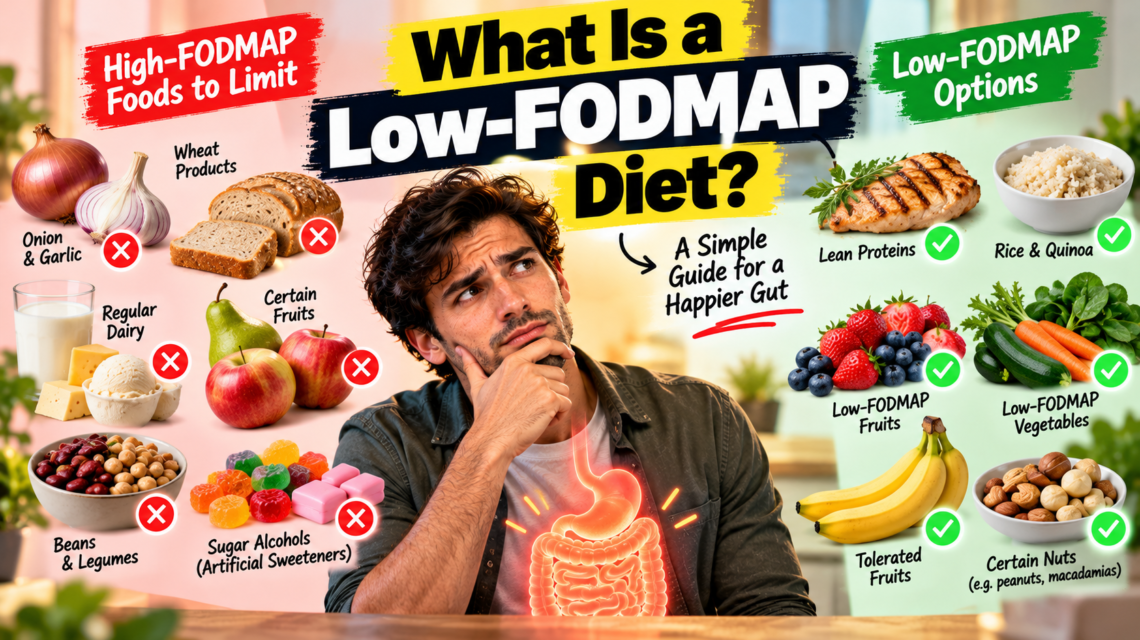
If you regularly deal with bloating, gas, stomach cramps, diarrhea, constipation, or unpredictable digestive symptoms, you may have heard of the low-FODMAP diet.
Unlike many popular diets, the low-FODMAP diet was not designed primarily for weight loss. It is a structured dietary approach used mainly to help people with irritable bowel syndrome (IBS) identify foods that may trigger their digestive symptoms.
The key word is identify. A low-FODMAP diet is generally not supposed to mean avoiding a huge list of foods forever.
Instead, it is designed as a temporary elimination and reintroduction process that helps you figure out which carbohydrates your gut can tolerate and in what amounts.
What Does FODMAP Mean?
FODMAP stands for:
Fermentable Oligosaccharides, Disaccharides, Monosaccharides And Polyols
That sounds complicated, but the basic idea is fairly simple.
FODMAPs are certain short-chain carbohydrates that are poorly absorbed or incompletely digested in the small intestine. When they reach the large intestine, bacteria ferment them and produce gas. They can also draw water into the intestine.
For someone with IBS, this combination of extra water, gas and intestinal stretching can contribute to symptoms such as bloating, abdominal pain, gas, diarrhea and constipation.
Importantly, FODMAPs are not inherently “bad” foods or toxins. Many healthy foods contain FODMAPs, and most people can eat them without significant problems.
The issue is that some people, particularly people with IBS, can be more sensitive to them.
What Foods Are High in FODMAPs?
FODMAPs are found in a surprisingly large number of everyday foods.
Some common high-FODMAP foods include:
- Onions and garlic
- Certain wheat-based foods
- Apples and pears
- Honey
- High-fructose corn syrup
- Regular milk and some other dairy products
- Beans and some legumes
- Cashews and pistachios
- Certain mushrooms
- Some sugar-free candies and gums
- Foods containing sugar alcohols such as sorbitol and mannitol
However, the amount matters.
A food isn’t necessarily simply “high FODMAP” or “low FODMAP” regardless of serving size. The amount you eat can influence whether you experience symptoms.
What Can You Eat on a Low-FODMAP Diet?
A low-FODMAP diet does not mean eating only bland foods.
There are plenty of foods that can form the basis of balanced meals.
Examples of commonly used low-FODMAP options include:
Protein
- Eggs
- Chicken
- Fish
- Beef
- Turkey
- Firm tofu
- Tempeh
Plain, minimally processed protein sources are often easier to incorporate into a low-FODMAP eating pattern.
Grains and carbohydrates
Depending on serving size and preparation, options can include:
- Rice
- Oats
- Quinoa
- Corn-based products
- Rice cakes
- Certain sourdough or wheat-free breads
Fruits
Some commonly used lower-FODMAP choices include:
- Bananas
- Strawberries
- Blueberries
- Kiwi
- Oranges
- Grapes
- Pineapple
Vegetables
Options can include:
- Carrots
- Cucumbers
- Bell peppers
- Spinach
- Eggplant
- Potatoes
- Tomatoes
- Zucchini
The important point is that low-FODMAP does not mean low-nutrition. A properly planned diet can still contain a wide variety of fruits, vegetables, proteins, grains and healthy fats.
High-FODMAP vs. Low-FODMAP Foods
| Food or ingredient | Common low-FODMAP alternative |
|---|---|
| Regular milk | Lactose-free milk |
| Onion | Green onion tops or infused oils |
| Garlic | Garlic-infused oil |
| Wheat-heavy bread | Suitable sourdough or gluten-free alternative |
| Honey | Maple syrup |
| Apples | Kiwi, oranges or strawberries |
| Cashews | Peanuts or macadamias |
| Sugar-free candy with sorbitol | Candy without polyol sweeteners |
| Some beans | Firm tofu or suitable portions of other protein sources |
This doesn’t mean the foods in the left column are universally unhealthy. It simply means they may contain FODMAPs that can cause problems for some people with IBS.
How Does the Low-FODMAP Diet Work?
The traditional approach has three stages.
Step 1: The Low-FODMAP Phase
During the first stage, high- and moderate-FODMAP foods are temporarily replaced with lower-FODMAP alternatives.
This phase generally lasts around 2 to 6 weeks, rather than indefinitely.
The goal isn’t to lose weight.
The goal is to determine whether reducing FODMAP intake improves your digestive symptoms.
If symptoms don’t improve, continuing to eliminate more and more foods may not be useful.
Step 2: Reintroduction
If your symptoms improve, the next step is to gradually reintroduce FODMAP-containing foods.
This is one of the most important parts of the process.
Instead of assuming that you can never eat onions, dairy, wheat or fruit again, foods are tested systematically to determine:
- Which FODMAP groups trigger symptoms
- How much you can tolerate
- Which foods you can eat without problems
- Whether symptoms depend on portion size
- Whether several FODMAP foods eaten together cause problems
The Monash approach describes testing individual FODMAP groups through structured food challenges.
Step 3: Personalization
The final goal is to create a personalized diet.
You may discover that you tolerate lactose but struggle with fructans.
Or you may tolerate small amounts of certain foods but experience symptoms when you eat larger portions.
Some people eventually reintroduce many foods that they initially removed.
The objective is therefore not “eat as little FODMAP as possible.”
The objective is eat as many foods as you can comfortably tolerate.
Does the Low-FODMAP Diet Actually Work?
Research suggests that a low-FODMAP approach can significantly improve IBS symptoms for many people.
Monash University reports that approximately 3 out of 4 people with IBS experience symptom improvement with a low-FODMAP diet.
Potential improvements include:
- Less bloating
- Less abdominal pain
- Less gas
- Better bowel regularity
- Reduced diarrhea
- Reduced constipation
- Better overall quality of life
However, it doesn’t work for everyone.
And it is important to understand that a low-FODMAP diet does not cure IBS. It is a tool for managing symptoms and identifying dietary triggers.
Is a Low-FODMAP Diet the Same as a Gluten-Free Diet?
No.
This is one of the biggest misconceptions about FODMAPs.
Wheat contains fructans, which are a type of FODMAP. Therefore, some wheat-based foods can be restricted during the elimination phase.
But that does not mean gluten is the problem.
A low-FODMAP diet is not automatically:
- Gluten-free
- Wheat-free
- Dairy-free
- Fructose-free
- Sugar-free
- Grain-free
In fact, Monash specifically notes that the diet isn’t designed to eliminate entire food groups unnecessarily.
If you suspect you have celiac disease, don’t simply start a gluten-free diet on your own before talking to a healthcare professional, because dietary changes can interfere with the diagnostic process.
Is the Low-FODMAP Diet Good for Gut Health?
This question is more complicated.
A low-FODMAP diet can be useful for controlling IBS symptoms, but stricter is not necessarily better.
FODMAP-containing foods include many fruits, vegetables, legumes and whole grains. Eliminating large numbers of these foods for long periods can make it harder to maintain adequate fiber and micronutrient intake.
There are also concerns about potential effects on the gut microbiome when the diet is followed too restrictively for too long.
That’s another reason the elimination phase is intended to be temporary.
The long-term goal is a personalized, minimally restrictive diet, not permanent avoidance of every high-FODMAP food.
Who Should Try a Low-FODMAP Diet?
The diet is primarily intended for people with medically diagnosed IBS.
If you frequently experience bloating, abdominal pain, diarrhea or constipation but have never been evaluated, don’t automatically assume that FODMAPs are the cause.
Digestive symptoms can have many different causes.
Monash recommends getting an appropriate medical assessment before starting a strict low-FODMAP diet because conditions such as celiac disease, inflammatory bowel disease and other gastrointestinal disorders can produce similar symptoms.
A registered dietitian experienced in IBS and FODMAPs can also make the process significantly easier.
What Does a Typical Low-FODMAP Day Look Like?
A simple day could look something like this:
Breakfast
Oatmeal with strawberries, kiwi and a suitable lactose-free yogurt.
Lunch
Grilled chicken with rice, spinach, carrots and a suitable dressing.
Snack
A portion of tolerated fruit with peanuts or another suitable nut.
Dinner
Grilled fish or tofu with potatoes and low-FODMAP vegetables.
Drink
Water, tea or another beverage that you know doesn’t trigger your symptoms.
The exact foods and serving sizes should be personalized because FODMAP tolerance varies.
How Do You Know Which Foods Trigger Your Symptoms?
A food and symptom diary can be extremely useful.
For several weeks, record:
What you ate:
Include ingredients and approximate portions.
When you ate it:
Note the time.
Symptoms:
Record bloating, gas, abdominal pain, diarrhea, constipation or other symptoms.
Severity:
For example, rate symptoms from 0 to 10.
Other factors:
Stress, sleep, exercise and menstrual cycle can also affect digestive symptoms for some people.
Patterns can become easier to see when you look at several days rather than judging a food based on one isolated reaction.
Don’t Blame Every Digestive Problem on FODMAPs
It can be tempting to see a list of FODMAP foods and assume that eliminating them will solve every digestive problem.
It won’t.
IBS symptoms can be influenced by many factors, including:
- Stress
- Sleep
- Meal size
- Fat intake
- Caffeine
- Alcohol
- Fiber intake
- Food intolerances
- Medications
- Gut-brain interactions
NIDDK notes that different dietary changes can help different people with IBS, and dietary approaches should be individualized.
In other words, FODMAPs are one piece of the puzzle.
Is the Low-FODMAP Diet a Weight-Loss Diet?
No.
Weight loss may happen if someone changes their overall food intake, but weight loss is not the purpose of a low-FODMAP diet.
The goal is digestive symptom management.
If you are already eating a restricted diet, adding another layer of food restriction purely for weight loss may make it unnecessarily difficult to get enough calories, protein, fiber and micronutrients.
Can You Follow a Low-FODMAP Diet Forever?
Generally, you shouldn’t think of the strict elimination phase as a permanent diet.
The traditional three-step approach is:
Restriction → Reintroduction → Personalization
The first stage identifies whether FODMAPs appear to be contributing to your symptoms.
The second identifies your specific triggers.
The third allows you to bring back as many foods as possible while maintaining symptom control.
That’s what makes the approach different from many elimination diets.
The end goal is not the smallest possible list of foods.
It’s the largest variety of foods your body can comfortably tolerate.
When Should You See a Doctor?
Don’t assume persistent digestive symptoms are simply IBS or food intolerance.
Seek medical evaluation if you have symptoms such as:
- Blood in your stool
- Unexplained weight loss
- Persistent vomiting
- Severe or worsening abdominal pain
- Difficulty swallowing
- Persistent diarrhea
- Significant changes in bowel habits
- Symptoms that repeatedly wake you from sleep
- Other symptoms that concern you
A healthcare professional can determine whether additional testing is appropriate.
The Bottom Line
The low-FODMAP diet is a structured approach to managing IBS symptoms by temporarily reducing certain poorly absorbed carbohydrates and then systematically reintroducing them.
It isn’t a detox.
It isn’t a weight-loss diet.
And it isn’t supposed to mean permanently avoiding every food that contains FODMAPs.
For people with IBS, it can be a useful way to identify individual food triggers and regain control over symptoms. But because the diet can become restrictive, the best approach is usually to use it as a structured process rather than simply cutting out foods indefinitely.
If digestive symptoms are a regular problem, understanding what a low-FODMAP diet is and how it works can be a useful first step toward figuring out what your gut actually tolerates.