
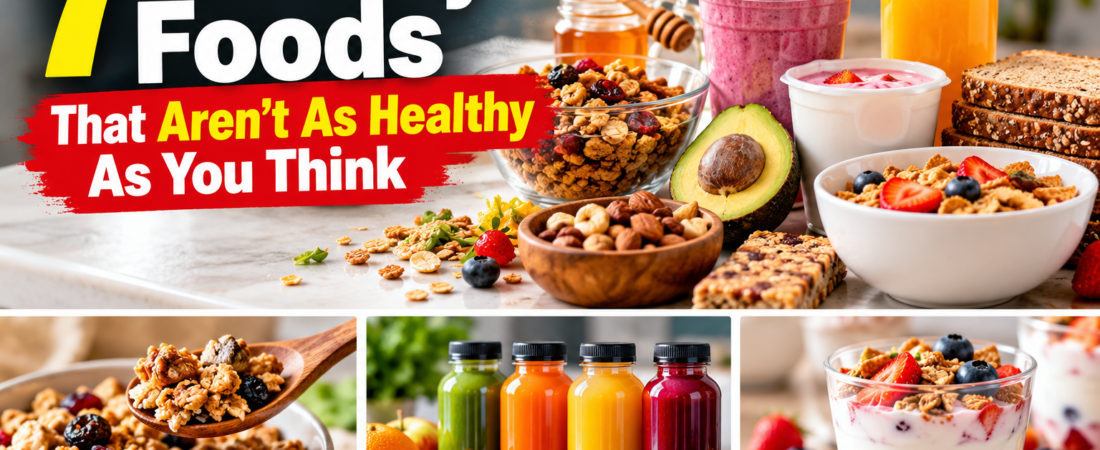
When you’re trying to eat healthier, it’s easy to assume that anything labelled natural, organic, protein-rich, multigrain or low-fat is automatically a good choice.
But nutrition isn’t quite that simple.
Some foods have developed a strong “health halo” — they sound healthy, look healthy and are marketed as healthy, but certain versions can contain surprisingly high amounts of added sugar, calories, sodium or refined carbohydrates.
That doesn’t mean you need to eliminate them from your diet. It simply means you should look beyond the marketing and understand what’s actually in your food.
Here are seven foods that deserve a closer look.
1. Granola
Granola is probably one of the biggest examples of a food with a health halo.
Oats, nuts, seeds and dried fruit can all be nutritious ingredients. The problem is what can be added to them.
Many commercial granolas contain sugar, honey, syrups and added oils to make them sweeter, crunchier and more enjoyable. Add a large serving of yogurt and fruit, and what started as a “healthy breakfast” can become a surprisingly calorie-dense meal.
What to watch for
- Added sugar
- Honey, maple syrup or other sweeteners
- Added oils
- Large portions
- Chocolate or sugar-coated dried fruit
A smarter choice
Look for granola with relatively little added sugar and a simple ingredient list. More importantly, watch the portion size.
Plain oats with nuts, seeds and fresh fruit can give you much more control over what goes into your breakfast.
2. Fruit Juice
“It’s made from fruit, so it must be healthy.”
Not necessarily.
Whole fruit comes with its natural fiber and requires more chewing, which can slow down how quickly you consume it. Juice removes much of that original structure and makes it easy to consume the sugars from several pieces of fruit in a short period.
Even juice labelled 100% fruit juice isn’t the same nutritionally as eating the whole fruit.
What to watch for
- Large serving sizes
- Concentrated fruit juice
- Juice blends
- Added sugar in some products
- Drinking juice instead of eating whole fruit
A smarter choice
Eat whole fruit more often and treat fruit juice as an occasional drink rather than automatically counting it as a serving of fruit.
3. Flavoured Yogurt
Yogurt can be an excellent source of protein and, depending on the product, calcium and beneficial cultures.
But the word “yogurt” doesn’t automatically mean low sugar.
Fruit-flavoured, dessert-style and some “healthy” yogurts can contain significant amounts of added sugar.
The packaging can make the product look nutritious while the ingredient list tells a different story.
What to watch for
- Added sugar
- Syrups
- Sweetened fruit preparations
- Dessert-style flavours
- Very large containers that encourage oversized servings
A smarter choice
Choose plain or unsweetened yogurt and add fresh fruit yourself. Greek yogurt can also be a convenient higher-protein option.
4. Smoothie and Acai Bowls
Smoothies and acai bowls can contain plenty of nutritious ingredients — berries, bananas, nuts and seeds, for example.
But there’s an important catch: healthy ingredients can still create a very calorie-dense meal when combined in large quantities.
A typical bowl may contain fruit puree, banana, fruit juice, granola, nut butter, honey and other toppings.
Each ingredient may be perfectly reasonable on its own. Together, they can create a meal containing substantially more calories and sugar than you might expect.
What to watch for
- Sweetened fruit puree
- Fruit juice
- Large amounts of granola
- Honey or syrups
- Multiple high-calorie toppings
- Very large serving sizes
A smarter choice
Build your own smoothie or bowl where possible. Use whole fruit, unsweetened yogurt or milk, and keep calorie-dense toppings such as nut butter and granola measured rather than unlimited.
5. Multigrain Bread
“Multigrain” sounds healthy — but the word doesn’t necessarily mean whole grain.
A multigrain product can contain several different grains while still being made largely from refined flour.
That’s why looking at the front of the package isn’t enough.
What to watch for
- Refined flour as the primary ingredient
- Added sugar
- Low fiber
- Marketing terms that don’t indicate whole grains
A smarter choice
Check the ingredient list and nutrition panel. Look for bread where whole-grain ingredients are prominent and the product provides a meaningful amount of dietary fiber.
“Multigrain” and “whole grain” aren’t interchangeable terms.
6. Protein Bars
Protein bars can be incredibly convenient, especially when you’re travelling, working or need a quick snack.
But “high protein” doesn’t automatically mean “healthy.”
Some protein bars contain substantial amounts of added sugar, syrups, fats and calories. Others are essentially candy bars with extra protein added.
The protein content is useful, but it shouldn’t be the only number you look at.
What to watch for
- Added sugars
- Syrups
- High calorie content
- Large portion sizes
- Long ingredient lists
- Low fiber
A smarter choice
Compare the protein, calories, fiber and added sugar rather than choosing a bar simply because the package says “protein.”
Depending on your needs, simpler snacks such as Greek yogurt, eggs, fruit with nuts or roasted legumes may also work well.
7. Nuts and Nut Butters
This one is especially tricky because nuts really are nutritious.
They’re a source of unsaturated fats, protein, fiber and several micronutrients. The problem is that they’re also highly energy-dense.
A small handful can contain a substantial number of calories, and nut butter is particularly easy to overeat because it is concentrated and requires almost no chewing.
Flavoured or coated nuts can add another layer of sugar, salt or oils.
What to watch for
- Large portions
- Sugar-coated nuts
- Salt-heavy varieties
- Chocolate-coated nuts
- Sweetened nut butters
A smarter choice
Choose plain nuts or minimally processed nut butter and pay attention to portions.
You don’t need to avoid nuts — just remember that nutritious and low-calorie are not the same thing.
The Bigger Lesson: Don’t Fear “Healthy” Foods
The point isn’t that granola, yogurt, fruit juice, nuts or protein bars are bad foods.
In fact, several of them can fit very comfortably into a healthy diet.
The real problem is the health halo.
A product can contain nutritious ingredients and still be high in calories, added sugar or sodium. Likewise, a food doesn’t become unhealthy simply because it contains fat or carbohydrates.
Instead of asking:
“Is this food healthy or unhealthy?”
ask:
- How much am I eating?
- How processed is it?
- Does it contain added sugar?
- How much fiber and protein does it provide?
- How calorie-dense is it?
- What does the ingredient list look like?
- Is the serving size realistic?
The simplest rule
Don’t judge a food by the words on the front of the package.
“Natural,” “organic,” “multigrain,” “protein,” “low-fat” and “made with real fruit” can all sound impressive — but the nutrition panel and ingredient list usually tell you much more.
And remember: no single food determines whether your overall diet is healthy.
It’s your overall eating pattern, portions, food quality and consistency that matter most.